2026
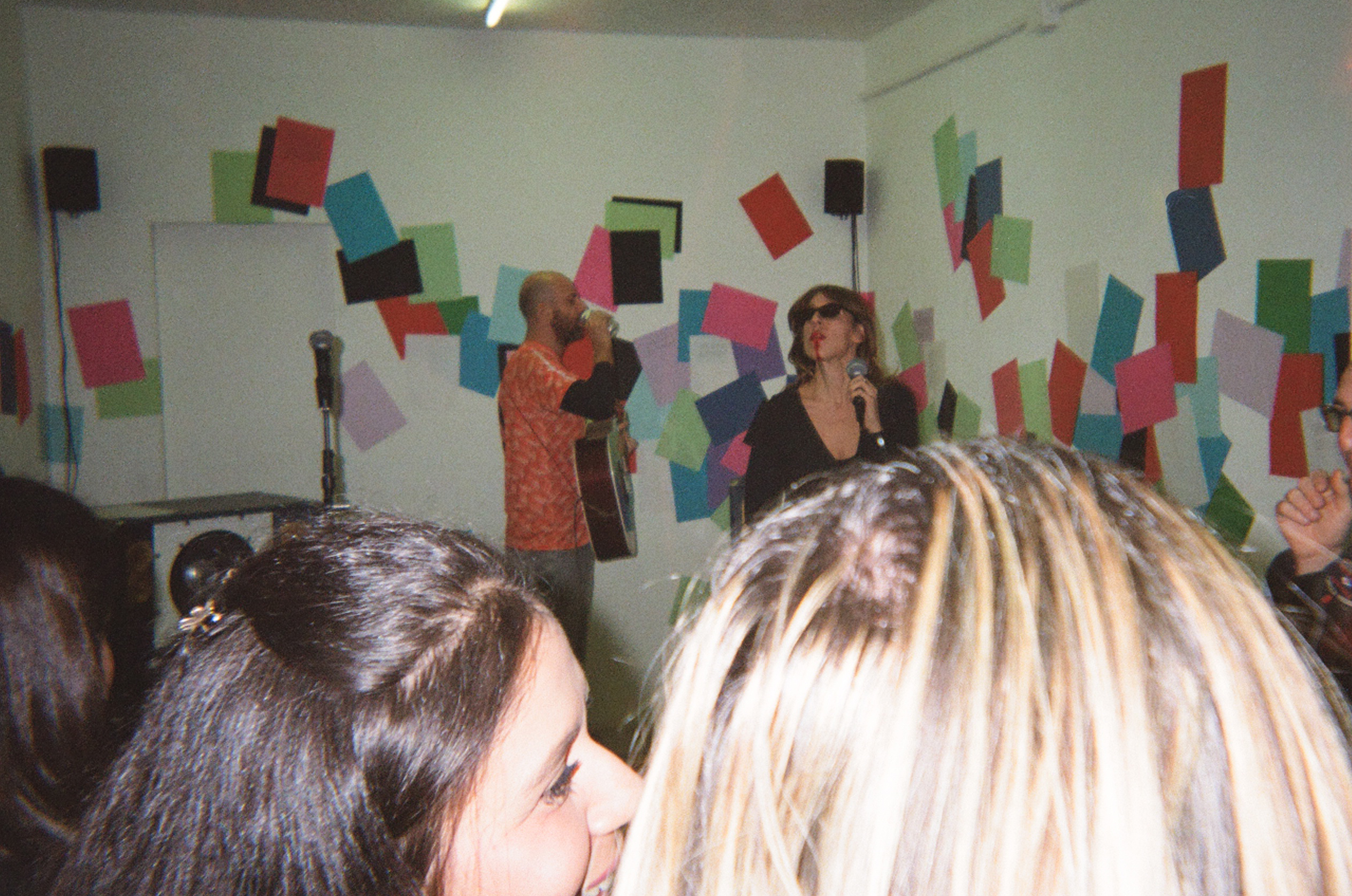
Carolina Cappelli, blood running from her nose, reads aloud a letter from the afterlife by Gino de Dominicis. The artist from Ancona complains about his life as an immortal in the world of the dead and asks MAXXI in Rome for clarification on two matters:
— the unpaid fee and travel expenses for his participation in the exhibition Tragicomica;
— the museum’s failure to take a position on the genocide of the Palestinian people.
2026
During training sessions ahead of the WNBA Finals, Natalie Nakase, coach of the Golden State Valkyries, plays the team an audio track consisting of explosions, gunshots and other sounds of war to prepare the players for the pressure of the decisive games.
2027
Carlotta Capobianco, project leader at Stefano Boeri Architetti, shows motorists a framed collage bearing the words “PER CASEY STIAMO” for the duration of a red light at the intersection of Lungarno del Tempio and Ponte San Nicolò in Florence.
2027
The reincarnation of Baba Vanga steals hundreds of thousands of thoughts from the minds of men, women and children around the world. She pours them into a boiling pot and cooks them with snake oil. At each full moon, she jars them while still boiling, in sterilised jars, leaving one centimetre of space at the top. After seven full moons she drinks the potion and writes her prophecies. On October 7, she trembles as she writes down the date of the end of the human race.
2027–2030
Students at a secondary school in Florence direct, act in and film Napoleon, faithfully following the screenplay Stanley Kubrick wrote in 1969 but never brought to the screen. The remake wins the Golden Lion at the 88th Venice International Film Festival.
2028
Since May 29, almost every evening before going to bed, I look at a photograph of Susan Hiller and me in Como. Then I go to sleep hoping to meet her and talk to her. I write down all our conversations. Even though she is not “a lucid dreamer.” Even though she is “dead.”
2028
Twenty people take part in a workshop in Paris. Each contributes a voice message from their smartphone and an instrumental piece of music. All the materials are archived and edited into a single track, in which the music accompanies the voice messages. At the end of the workshop, the composition is played for the participants.
2029
Naples, Piazza del Plebiscito. A Tesla Cybertruck is parked in the centre of the square. Beside it, a long table holds seventy-two objects, including a fire extinguisher, thirteen spray cans, a flamethrower, a bunch of keys, six eggs, lipstick, a chain, a jar of honey, a pair of scissors and a whip. For six hours, the public is invited to use the objects against the vehicle however they see fit.
2029
Chicken Joe, the carefree, good-natured surfing rooster known as the deuteragonist of the animated mockumentary Surf’s Up, reads Vita meravigliosa by Patrizia Cavalli aloud in front of the ocean.
2029
Alessandro Fogo, Paola Angelini and Luca De Angelis each make a painting with the same title: At Dusk, Victor Man Confesses the Sins of His Life in Great Detail in the Main Hall of the Cluj Academy Before an Audience of Thirty-Seven Primary School Children.
2029
Dressed as Simone Forti, I dance on tiptoe in a room full of politically sensitive subjects. Towards the end of the performance, I trip over a trap sculpture dedicated to inclusive language: a mountain of shit spills over my body.
2029
I go to Parco del Mezzetta in Florence. When I see an elderly couple sitting on a bench, I approach them, open my laptop and give them a Keynote presentation about the history of my family.
2030
Thomas Berra is a painter who lives and works in the Cosmos. In May, he eats Salvia divinorum. He becomes the moon for 322 years. Seven minutes later he returns to reality and we go out for a Nutella crêpe.
2030
Francesco Fassone, a set designer from Asti, designs and builds a three-metre-high wooden pyre. On its different levels, he places dozens of portable JBL speakers. Each plays the sound of a different fire recorded in the countryside around Asti. The sculpture is a monument to Town, Zar, Blu and Donnie.
2030
A group of partisan zombies haunts Netanyahu’s bedroom for the rest of his life. After his death, they pass the baton to Baba Yaga, in the form in which she appears in a 1990s children’s book. The witch continues to terrorise him and gives him no peace.
2030
The protagonists of my maternal and paternal family trees materialise in front of the Vismarkt in Groningen. For an hour they exchange pleasantries, then warmly say goodbye and return to their respective branches. Ortensio joins the wrong family. The mistake opens a rupture in space-time through which an aircraft engine falls.
2030
On a wall in a white room, the words “The sound of a piano the size of a mountain” are painted in black Futura Extra Bold. A state-of-the-art sound system is installed in the room. The system is connected to an adjacent room where, each week, a composer attempts to reproduce the described sound using whatever technologies they consider necessary. The audience listens to their experiments without seeing the source.
2031
Luca De Leva, artist and founder of Thyself Agency, swaps lives for one week with The Anatomy Lesson of Dr. Nicolaes Tulp, a 1632 oil painting by the Dutch painter Rembrandt.
2031
The Beaver Patrol, led by the brave Girl Scout Valeria Mancinelli, emerges from a wound in the first Indigenous person to spot Christopher Columbus’s caravels. In the jungle, the platoon encounters a fascist rat that fled Europe a month earlier. They chase it, beat it mercilessly and multiply its flesh. They cook it with potatoes and serve it to the entire crew of the Genoese explorer, approximately 120 men, along with a chalice of sacred liqueur laced with poison.
2032
At sunset, the audience gathers on the large terrace at Via Zara 5 in Senigallia, overlooking the Rotonda. Two acoustic guitars play in the background. About a hundred metres away, Andrea Zucchi, an architect and Carlotta Capobianco’s partner, stops passers-by and asks each of them, “Am I in a dream?” A microphone connected to the speakers on the terrace lets the audience listen to the conversations. Two pairs of binoculars are passed from hand to hand among the spectators.
2032
Twenty-seven sculptors of sand dogs gather in a huge hangar. Every night, from midnight to 6 a.m., breaks are orchestrated so that at least fifteen artists are always at work. They shape sleepy puppies and enormous beasts using sand from beaches around the world and water from the five oceans. Renascent by The Durutti Column plays in the background. Three pendulum clocks from the 1930s are placed around the space.
2032
Nadia, a Tibetan monk, Valenji, Joan of Arc and a bishop play the silence game in a villa in the hills around Asti. The game takes place among the building’s pink rooms, the orangery and the hazelnut grove. A small film crew records them without intervening. At times the game becomes a fierce competition; at others, a profound spiritual exercise. The film is screened at the Cannes Film Festival while none of the five has yet uttered a word.
2032
Someone whose name I will not reveal travels to Brazil, falls in love and takes acid. The next morning, they have learned Portuguese.
2033
Riccardo Fassone, professor of History and Theories of Playful Forms at the University of Turin, gives a lecture on the meaning of play throughout human history. Afterwards, at the centre of the stage in Stockholm University’s main auditorium, he restages the austere cover of the reissue of Marduk’s first demo.
2033
Ottessa Moshfegh, Veronica Raimo, Brunella Cartasegna, Erykah Badu, Gillian Wearing, Francesca Comisso, Gloria de Risi and the ghost of my mother take turns reading aloud a text that has deeply affected them. When they are not reading, they film one another with a Sony FDR-AX700. A cat allows itself to be stroked. A sheepdog sleeps by the fire.
2033
At the Guggenheim in New York, during an exhibition devoted to so-called zombie formalism, visitors can choose whether or not to take an audio guide. The recording contains every comment, insult and negative opinion expressed about the person listening to it over the course of their life.
2033
My cousin Pizzi brings me issue number one of Nathan Never. He has returned from military service and is muscular, handsome and friendly. He gives me a fountain pen. He tells me he has found space inside the body of a girl named Letizia.
2034
Outside Andrea del Sarto primary school in Florence, at the end of the first day of school, a clown sings Love Will Tear Us Apart, loudly and in tears.
2034
The shadow of Monsieur Hulot and a wandering thought dance in an empty nightclub.
2034
A group of cannibals cooks a French philosopher, stuffed with pythons and baked au gratin.
2035
A large language model retrieves, catalogues and digitises a series of occult documents from the past. Among them:
— a letter from Nosferatu to Dr. Knock;
— a series of charcoal circles drawn by Louise Bourgeois to illustrate her fears;
— the setlist from Aldous Harding’s concert on June 29, 2026, at the Locomotiv Club in Bologna;
— an idea from Paul McCartney for Ringo Starr;
— a sheet of automatic writing by my aunt.
2035
Mattia Pajè appears in a dream to Freddie Krueger, who kills Andrea Scanzi in a dream.
2035
A group of nuns on holiday enters the Amnesia coffeeshop in Amsterdam and orders a pre-rolled Dripwood Strawberry Haze joint.
2035
A giant rabbit animates the corpse of Joseph Beuys like a puppet, teaching him to consult crystal balls.
2035
Imagine reversing paranoia. You enter an infinite loop of positive thoughts. What joy!
2036
Janelle Monáe, the American singer and songwriter, travels through time. Destination: October 1, 1985, two months before her birth. She has fifteen days to design and install a structure of mats and trampolines capable of preventing Ana Mendieta’s death and shedding light on the figure of Carl Andre.
2036
Nina Silvestri, artist and choreographer, repeats, movement by movement, everything a drunken spectator from Genoa did during The Brian Jonestown Massacre concert on November 3, 2016, at Spazio 211 in Turin.
Roberto Fassone (1917, Alexandria, Egypt) lives and works in the metaphors we live by. His writings, performances and films have been presented in a range of contexts, including Fanta-MLN, Visions du Réel, Rencontres Internationales, Onassis ONX, Ars Electronica, MAXXI, Palazzo Collicola, Museo Nazionale del Cinema, Palazzetto dello Sport di Venaria and Gelateria Sogni di Ghiaccio.
He often thinks about the question: why do we exist?
At this very specific moment, while writing this biography, his favorite artist is Susan Hiller, whom he met in 2011 on Lake Como. At the time, he did not understand her work. What a pity.
If you are interested in his work, you can write to him at roberto.fassone[at]gmail.com